Get in touch if you have forms, order slips, reports, contracts, application forms, reply cards (campaigns) or similar that you want to convert quickly into a database.
We use either fixed-form data capture technology (the same as used for surveys) or flexible data-capture technology when interpreting forms, as the latter does not require the registration marks normally used with fixed-form technology, e.g. surveys.
Interpreting forms with flexible data-capture technology
Interpretation with flexible data-capture technology works quite differently from the interpretation of fixed forms, with reference marks and fields in fixed positions. Instead of interpreting fixed positions, it relies on using OCR to locate predefined anchor words, such as "Contract", "contract no.", "Order no.", "Order slip:", "Report no.:" or similar, and then setting conditions for finding a suitable character string near the anchor, or at least in relation to it. You set conditions for what the sought character string should look like, such as the number of characters, which characters are permitted, and so on. See below the anchor word "REPORT" in blue and the captured report number in green.
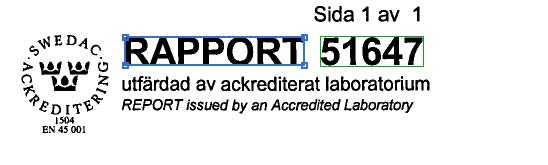
The same type of contract often looks identical, but it only takes one of the contracts being a photocopy, or printed on a different printer, for it to no longer match a fixed-form template, where the demands for millimetre precision are high. A good example of when this is bound to happen is if you post a PDF containing, for instance, an application form for a new share issue that is then downloaded by various people and subsequently printed on different printers. In that case, the flexible data-capture technology for semi-structured forms is preferable instead.
AI data capture – an alternative and complement to classic OCR
The AI image-interpretation models of recent years have given us a powerful complement to classic OCR and template-based data capture. Instead of locating anchor words in fixed positions, the AI reads the page more the way a human does – it understands what a field means from the context, even when the form looks different from last time. That lets us take on material that would previously have required manual keying.
Where AI reading helps most
- Forms without a uniform template: when every submitted copy looks slightly different and no fixed template fits.
- Hard-to-read originals: photocopies, copies of copies, skewed scans, faint printouts and old documents.
- Handwritten entries: filled-in fields, marginal notes and signature lines that traditional OCR cannot handle.
- Fields that require understanding: telling a personal identity number from a company registration number, finding the right date among several, or deciding which of two numbers on the page is the contract number.
AI as a proofreader of OCR-captured data
Perhaps the most important use for us is the AI as a second pair of eyes. Once data has been captured by OCR or data-capture technology, we have the AI re-read every uncertain entry directly from the scanned image and compare it with what ended up in the database. That catches exactly the errors that are hardest to detect mechanically: the digit 1 read as the letter l or I, 0 as O, and run-together or truncated words.
We have built this check for exactly the kind of short data fields that forms contain – numbers, dates and amounts, but also names, e-mail addresses and shorter free text. Every uncertain entry is checked against the original image before delivery.
Always checked against the original image
An AI model can guess wrong, and a guess that looks plausible is more dangerous than an obvious OCR error. That is why we never use AI reading unchecked. Every entry is validated both deterministically against rules we define – number of characters, permitted characters, check digit, lookup against a register – and visually against the scanned image. Anything that cannot be substantiated against the image goes on to manual review.
In addition, AI data capture is often combined with a final round in which I go through the results against the image with my own eyes. Automated validation and the AI check catch most things, but it is in that last pass that the occasional odd error tends to surface. That is also why I dare promise such high accuracy on assignments of this kind.
We choose the technique to suit the material
Fixed form technology, flexible data capture and AI reading do not exclude one another – we often combine them within the same assignment and let each technique do what it does best. Do send us a few sample pages, for instance photos taken with your phone, and we will come back with a proposed approach and a price.